Text: Exodus 4:1-17
Introduction: Beyond Our Excuses
Good morning, church family. Whether you are a long-time member here at 14 Sandringham Street or joining us for the first time, welcome to a place “Where Love and Grace Abound” as we seek to live in faithful obedience to Jesus Christ.
Every Sunday, when we gather, we pass on a truth inscribed on our hearts and in our church ethos: “Enter to Worship, Depart to Serve“.
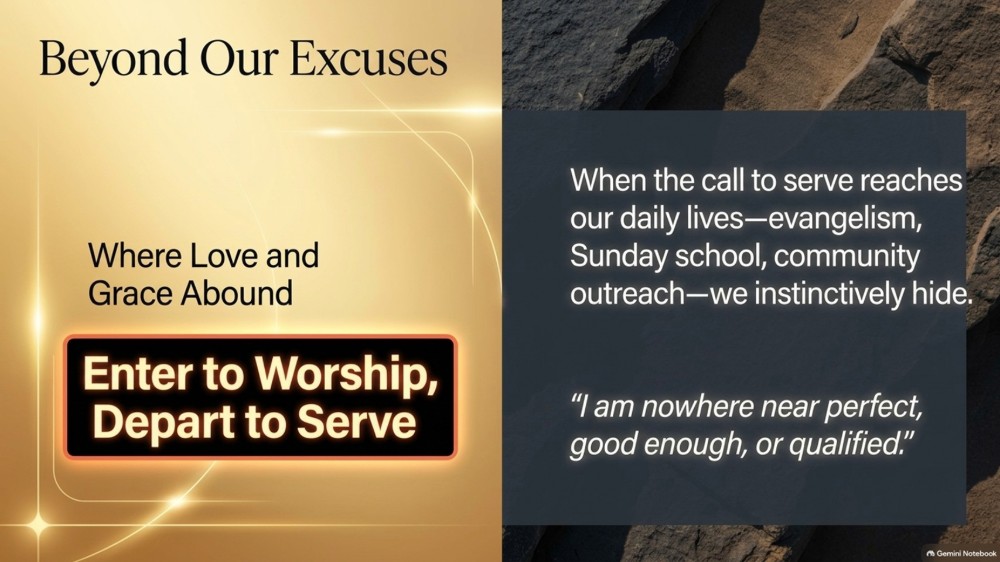
Yet when the call to depart and serve reaches our daily lives—whether in personal evangelism, Sunday school, community outreach, or lay leadership—how do we respond?
If we are honest, many of us readily say, “I am nowhere near perfect, good enough, or qualified”. We hide behind a thousand and one well-crafted excuses.
This morning, we turn to Exodus 3 and 4, where Moses stood before the Almighty at the burning bush. God commanded Moses to assemble the elders of Israel and declare that the Lord had seen their misery in Egypt and promised to bring them up into a land flowing with milk and honey.
Yet, when faced with God’s extraordinary commission, Moses produced excuse after excuse. Today, we explore “When God Silences Our Excuses Not to Serve.”
Point 1: The Three Signs — God’s Divine Proofs Then and Now
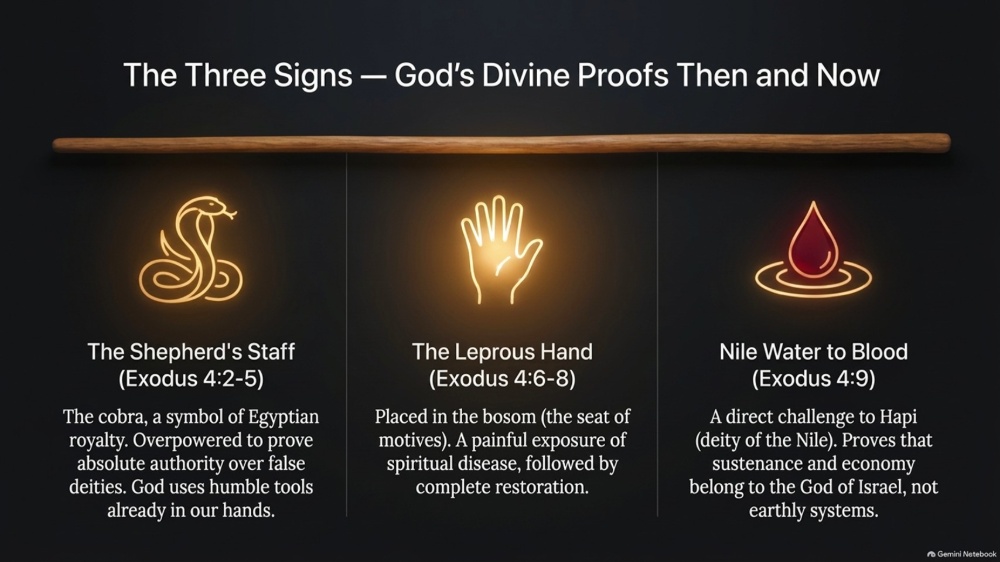
In Exodus 4:1–9, God provided Moses with three supernatural signs to authenticate His divine commission:
- The Shepherd’s Staff (Exodus 4:2–5): God asked Moses, “What is that in your hand?” Moses held a simple wooden staff from his forty years of tending sheep. When thrown down, it turned into a living serpent; when caught by the tail, it became a staff again.
In Egyptian culture, royalty wore the cobra as a symbol of divine sovereignty. By controlling the snake, God proved His absolute authority over Egypt’s false deities. Furthermore, God demonstrated that He uses whatever humble tools are already in our hands. - The Leprous Hand (Exodus 4:6–8): The sign of the leprous hand serves as a profound spiritual metaphor for inner transformation, where the drawing out of the leprous hand represents the painful but necessary exposure of our fallen human nature, and its subsequent restoration symbolises the convicting, regenerating work of the Holy Spirit.
By placing his hand into his bosom—the biblical seat of the heart and human motives—Moses witnesses a vivid picture of the spiritual disease that dwells within us.
Yet, when the hand is pulled out a second time completely whole, it mirrors how the Holy Spirit applies God’s cleansing power directly to our hidden wounds, exchanging guilt for a humbling, steady peace. - Nile Water Turned to Blood (Exodus 4:9): Moses was instructed to pour water from the Nile onto dry land, where it turned to blood. The Nile was Egypt’s idolised source of life and economy. The ancient Egyptians worshipped Hapi, the personification of the Nile’s annual inundation (flooding), which brought fertile silt and agricultural wealth.
Turning the Nile River’s water into blood, the first plague, is understood as a direct challenge to Egyptian reliance on the Nile and deities such as Hapi, showing that sustenance and power belong to the God of Israel rather than to Egypt’s natural or divine systems.
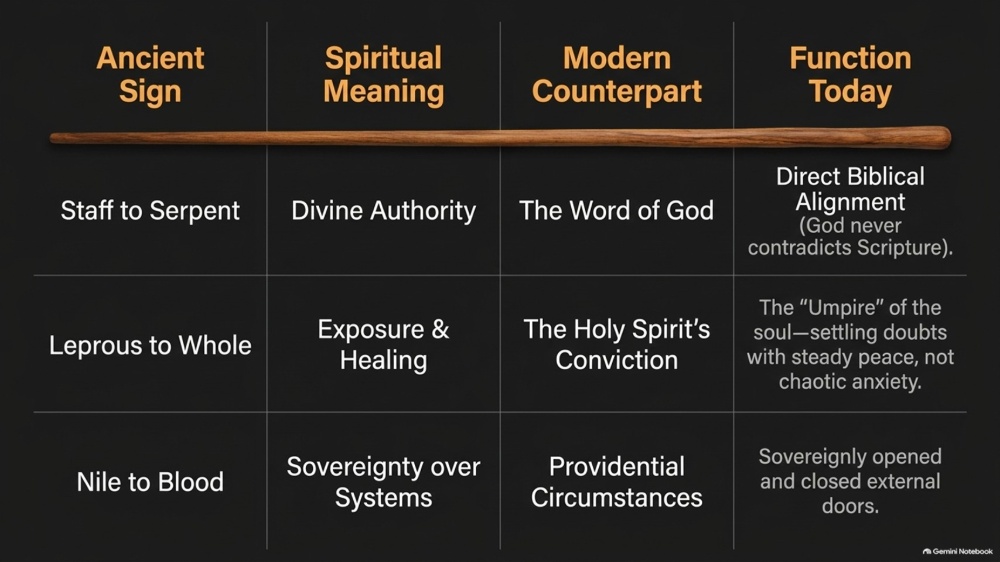
As Baptist believers who hold that the biblical canon is complete, we do not expect wooden rods to turn into snakes in our daily ministry. However, we can take note that God provides three modern counterparts that align perfectly as proof of His voice:
- The Staff becomes the Word of God: Just as the staff represented divine authority, our primary, non-negotiable proof today is direct biblical alignment. God will never lead a believer to do anything that contradicts His written Word, the Holy Bible.
- The Leprous Hand becomes The Holy Spirit’s Conviction: The inner transformation of the hand parallels the conviction and peace of the Holy Spirit in the believer’s heart.
When God speaks, it is not accompanied by chaotic anxiety, but by a humbling clarity. The Holy Spirit settles conflicting internal emotions, ruling over doubts and fears, and leaving the believer with a profound sense of divine order.
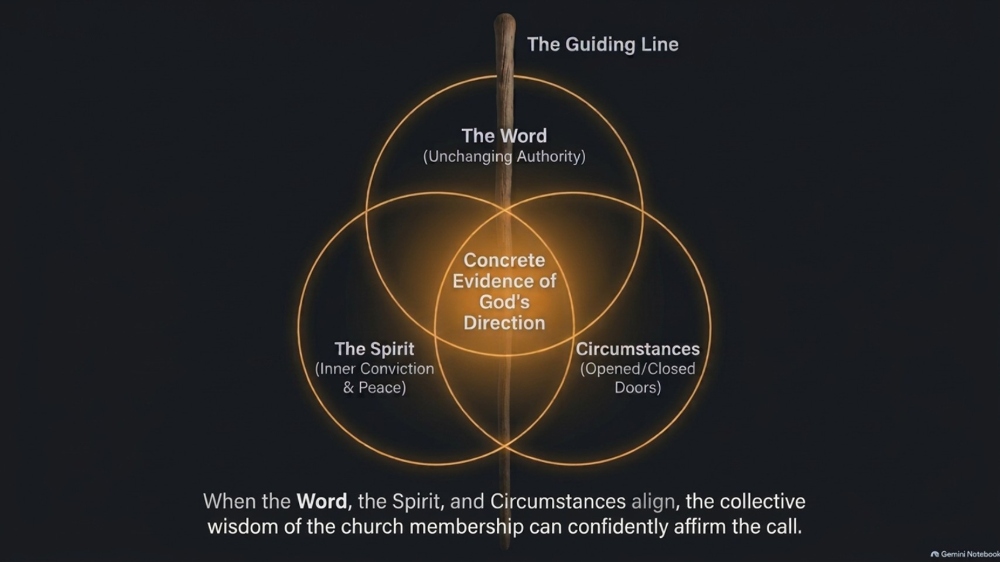
- In Moses’ context, which involved the whole nation of Israel, God commanded him to speak to the elders. In our context as a church, we bring it to the collective wisdom of the elders or the whole church membership for testing.
Ultimately, this miraculous rhythm of exposure and healing establishes the Holy Spirit as the “judge” of the believer’s soul; He gently but firmly arbitrates our internal world by convicting us when we drift, and settling our doubts with an undeniable, life-giving peace whenever we walk in alignment with His voice.
- Turning Water to Blood becomes Providential Circumstances: External realities are shaped through doors sovereignly opened and closed.
- When the Word, the Spirit, and Circumstances line up, we have concrete evidence of God’s direction.
Point 2: Moses’ Excuses and Modern Baptist Realities
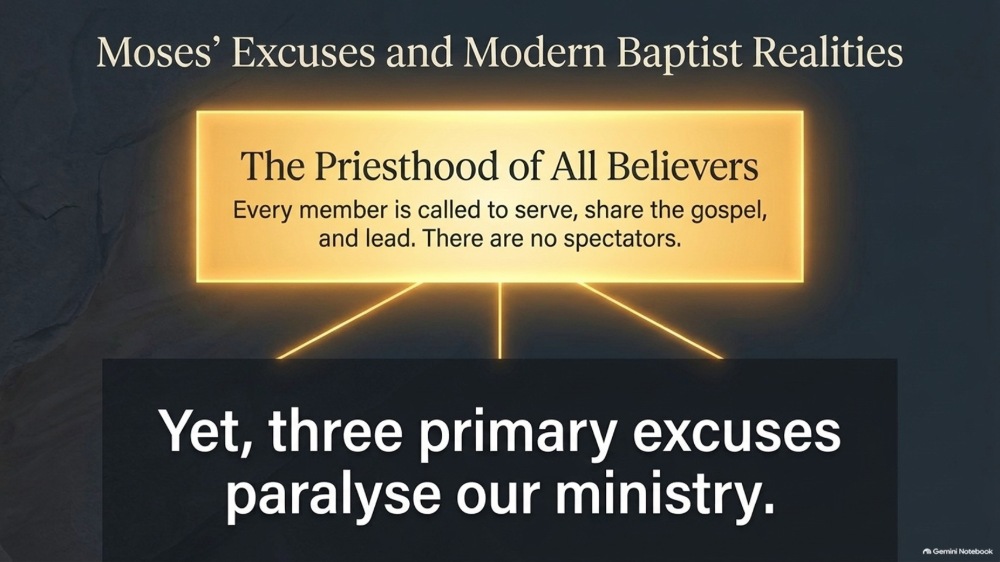
Despite these supernatural demonstrations, Moses kept objecting. His ancient excuses mirror the rationales we hear across local Baptist churches today.
In our Baptist ecclesiology (the branch of Christian theology that studies the nature, origins, purpose, leadership, and organisation of the Christian church), we hold firmly to the priesthood of all believers—meaning every member is called to serve, share the gospel, and lead.
Yet, three primary excuses paralyse our ministry:
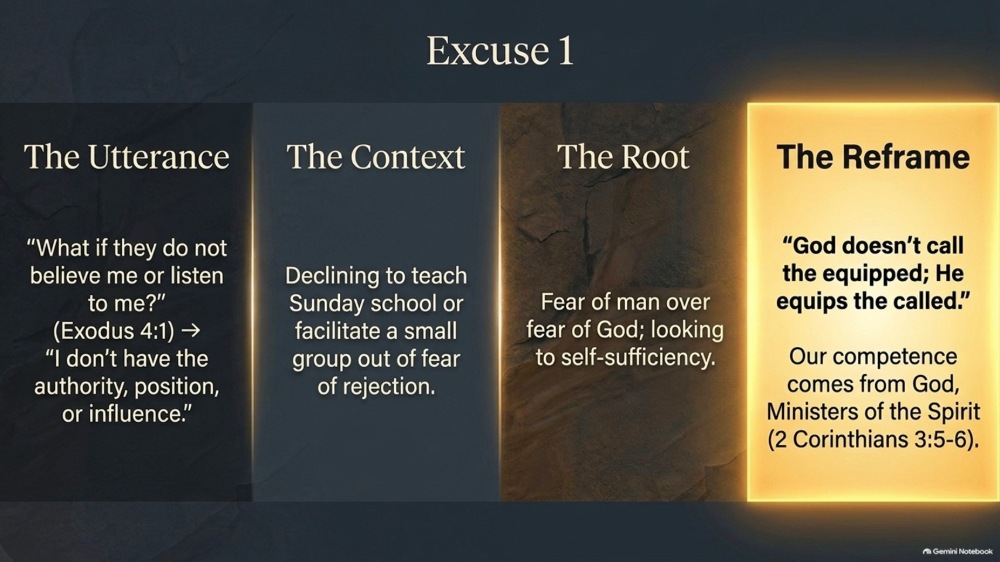
Excuse 1: “What if they do not believe me or listen to me?” (Exodus 4:1)
- The Modern Excuse: “I don’t have the authority, position, or influence to make a difference.”
- The Church Context: Members decline to teach Sunday school, facilitate a small group, or participate in local outreach because they fear rejection or feel uncredentialed.
- The Root Spiritual Issue: Fear of man over fear of God. Moses looked to his own sufficiency rather than God’s power. The popular Christian proverb declares: “God doesn’t call the equipped; He equips the called.”
2 Corinthians 3:5-6 – Not that we are competent in ourselves to claim anything for ourselves, but our competence comes from God. 6 He has made us competent as ministers of a new covenant—not of the letter but of the Spirit; for the letter kills, but the Spirit gives life.
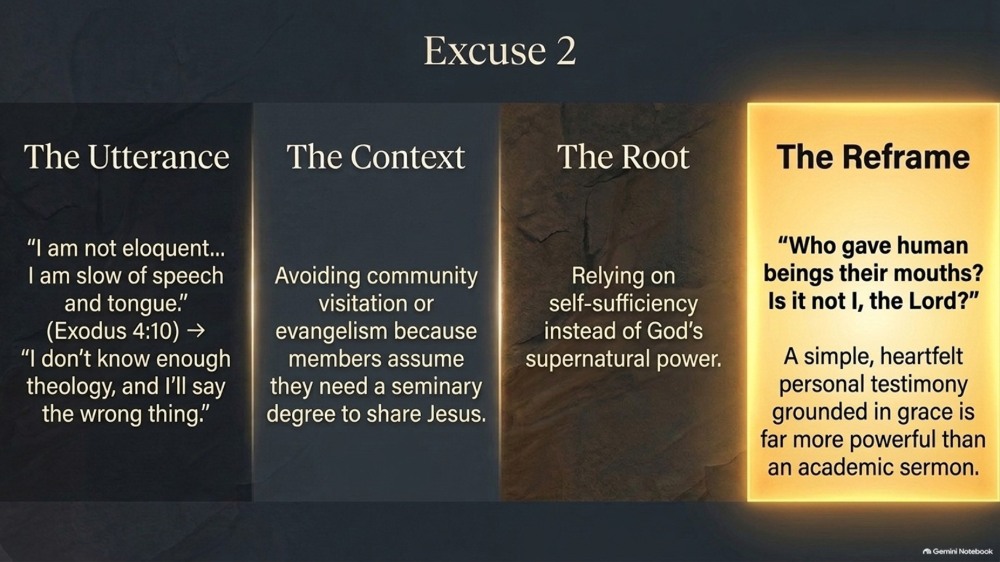
Excuse 2: “I am not eloquent… I am slow of speech and tongue” (Exodus 4:10)
- The Modern Excuse: “I don’t know enough theology, and I’ll say the wrong thing.”
- The Church Context: This is the most common reason members give when invited to participate in community visitation, global missions, or personal evangelism. Members assume they need a seminary degree to share Jesus.
- The Root Spiritual Issue: Relying on self-sufficiency instead of God’s supernatural power. Evangelist Dwight L. Moody pointed out that God does not demand silver-tongued orators; He demands willing vessels.
God responded to Moses by asking, “Who gave human beings their mouths?… Is it not I, the Lord? Now go; I will help you speak.”
A simple, heartfelt personal testimony grounded in God’s grace is far more powerful than an academic sermon.
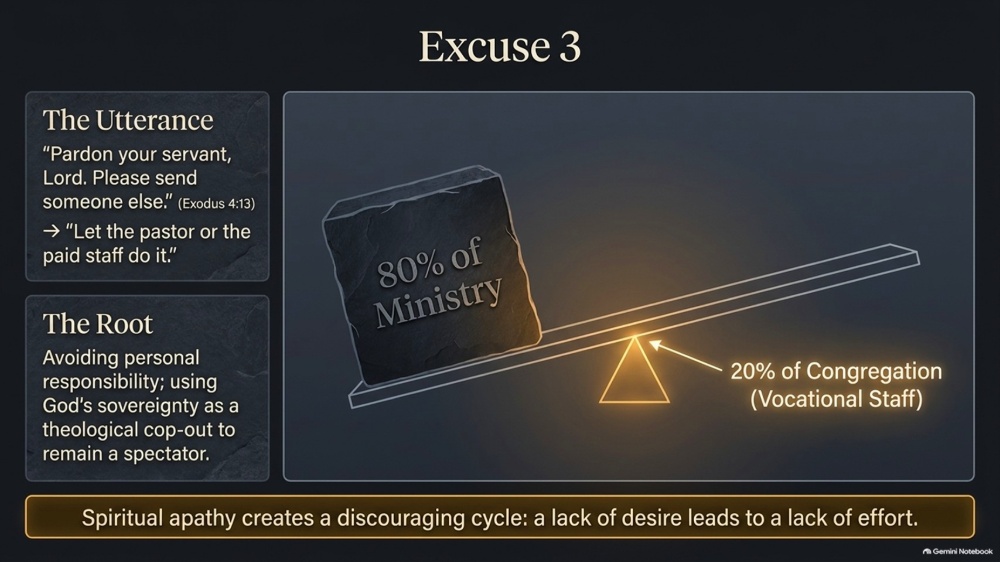
Excuse 3: “Pardon your servant, Lord. Please send someone else.” (Exodus 4:13)
- The Modern Excuse: “Let the pastor or the paid staff do it.”
- The Church Context: This attitude creates the “80/20 rule” in local churches, where 20% of the congregation performs 80% of the ministry. Members treat church as a spectator sport, expecting vocational staff to handle all caregiving and soul winning.
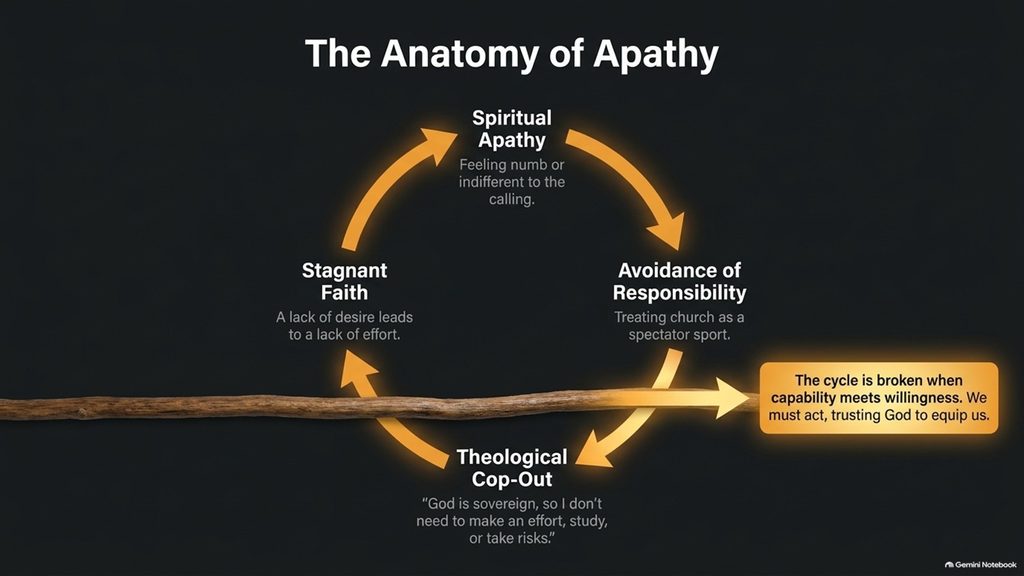
- The Root Spiritual Issue: Avoiding personal responsibility and spiritual apathy.
- Avoiding personal responsibility and spiritual apathy can quietly hinder a believer’s faith, turning God’s promise to equip us into a reason to hold back.
- Spiritual apathy can leave us feeling numb or indifferent, draining the passion to pursue our calling and making it easier to settle for staying where we are.
- That indifference can lead us to neglect our responsibilities, using God’s sovereignty as a theological cop-out—as though God providing strength means we don’t need to try, study, or take risks.
- Together, these habits can form a discouraging cycle: a lack of desire leads to a lack of effort.
- Yet biblical growth calls us to act; God multiplies our steps as we take responsibility and move forward.
- God did not give Moses a new mouth
- He did not give Moses a magical army.
- He told Moses to take the exact same ordinary piece of wood he had carried for 40 years and start walking.
- Avoiding personal responsibility and spiritual apathy can quietly hinder a believer’s faith, turning God’s promise to equip us into a reason to hold back.
- We observed that Moses’ final excuse was purely a matter of will, not capability
When we ask God to send someone else, we choose comfortable disobedience over sacrificial faith. Scripture records that at this point, “the Lord’s anger burned against Moses”.
God conceded to send Aaron as a spokesman, but Aaron later brought significant trial and spiritual compromise to Moses’ leadership.
Conclusion: Laying Down Our Excuses
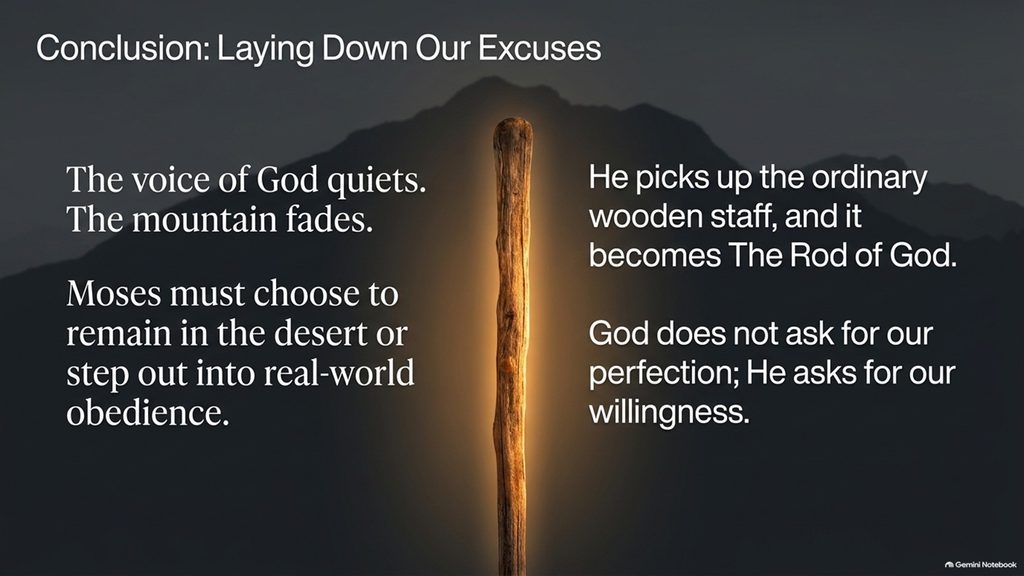
When the fire of the burning bush quieted across the desert, Moses faced an unmistakable turning point. He could either retreat into comfortable hesitation or step forward in active, real-world obedience.
Scripture records that Moses reached down, took the simple shepherd’s staff—now transformed into “the staff of God”—and returned to Egypt to fulfil his divine assignment.
The hidden pattern reveals that Moses was never actually experiencing a capability deficit; he was experiencing a submission deficit. His final plea (“Please send someone else”) exposes that “I can’t” was simply a mask for “I won’t”.
Brothers and sisters at Oamaru Baptist Church, as we prepare to transition from “Enter to Worship” to “Depart to Serve,” the same God calls out to each of us today. In our Baptist understanding of the priesthood of all believers, ministry is never a spectator sport meant solely for paid pastoral staff—it is the shared joy and personal responsibility of every single member.
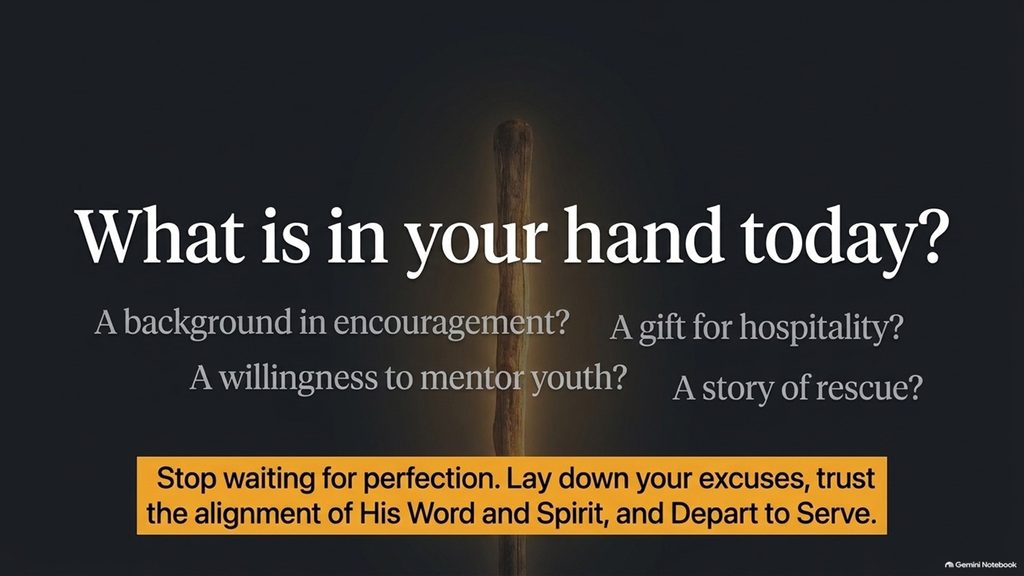
Ask yourself this morning: What has God placed in your hand? Is it a spirit of encouragement, a gift for hospitality over a cup of coffee after service, a passion to teach Sunday school, or simply a heartfelt testimony of how Christ rescued your life?
When you lay down your excuses and actively participate in the life and service of our church family, two enduring transformations take place:
- For God’s Eternal Glory: Sacrificial, willing service exalts the Master who equipped you, demonstrating to a watching world that His strength is made perfect in human weakness. As Jesus reminds us, “Blessed is that servant whom his master will find so doing when he comes” (Matthew 24:46)
- For a Fulfilling Believer’s Life: Passive Christianity leads to spiritual apathy but stepping into your calling unlocks a deeply satisfying life of faith. You experience the joy of seeing lives transformed, unshakeable Holy Spirit peace in decision-making, and the rich fellowship of a caring church.
When Moses finally bent down and picked up the staff in obedience, his will aligned with God’s command—and that ordinary piece of wood instantly became “the staff of God”.
We must stop viewing our everyday gifts as inadequate tools, and instead see them as divine instruments waiting to be activated by a willing heart.
Let us stop waiting until we feel flawless, invincible, or seminary-trained. Our Lord does not demand silver-tongued perfection; He asks for a willing heart.
May we choose sacrificial faith over comfortable disobedience, hold fast to our calling, and live in faithful obedience to Jesus Christ—for His glory, for our spiritual growth, and for the blessing of His church.
Amen.

Leave a Reply